
The rise of therapeutic oligonucleotides has transformed modern medicine, offering solutions for diseases once considered undruggable. As these therapies progress from niche applications to mainstream treatments, the demand for efficient, scalable, and sustainable oligonucleotide manufacturing has become a critical concern.
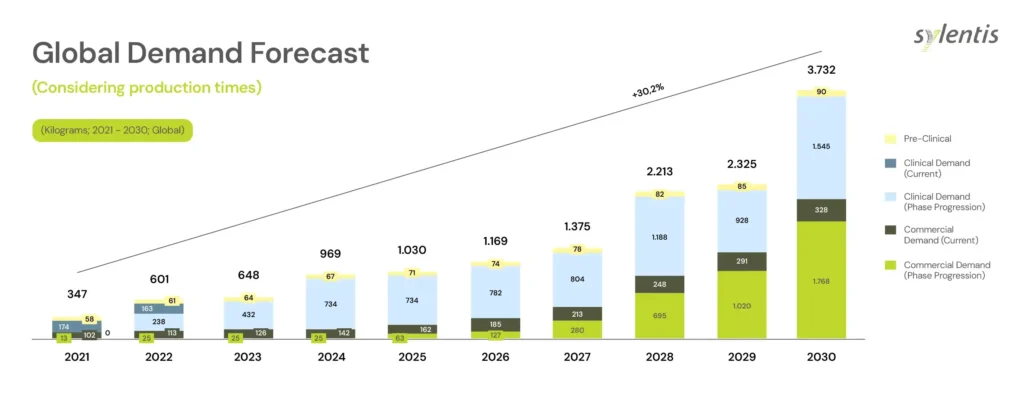
Figure 1. Global demand forecast of oligonucleotide manufacturing from 2021 to 2030.
Scaling up production while maintaining purity and addressing environmental impact presents significant hurdles. However, recent advancements in synthesis methods, purification strategies, and facility design are paving the way for a more robust oligonucleotide manufacturing landscape.
Challenges in Scaling Up Upstream of Oligonucleotide Manufacturing
The therapeutic oligonucleotides manufacturing process typically follows a standardized four-step cycle based on solid-phase phosphoramidite chemistry. The process begins with a solid support functionalized with the first nucleotide. Each synthesis cycle adds one nucleotide in the 3′ to 5′ direction and includes the following steps (Figure 2):
- Detritylation: The 5’-DMT protecting group is removed to expose the hydroxyl group for the next phosphoramidite.
- Activation and Coupling: The incoming phosphoramidite monomer is activated and coupled to the growing chain.
- Capping: Unreacted 5′-hydroxyl groups are capped to prevent chain extension.
- Oxidation or Thiolation: The phosphite linkage is oxidized to a phosphate or thiolated to form a phosphorothioate linkage.
After the full sequence is assembled, the oligonucleotide is cleaved from the solid support and all protecting groups are removed during the final deprotection step.

Figure 2. Oligonucleotide synthesis cycle. DMT = 4,4′-dimethoxytrityl, BASE(pg) = nucleobase with appropriate protecting group R = H (for 2′-deoxy nucleotides) or other modifications. Source: Andrews BI, Antia FD, Brueggemeier SB, Diorazio LJ, Koenig SG, Kopach ME, Lee H, Olbrich M, Watson AL. Sustainability Challenges and Opportunities in Oligonucleotide Manufacturing. J Org Chem. 2021 Jan 1;86(1):49-61
The solid-phase phosphoramidite chemistry method was originally designed for small-scale production. While this technique offers flexibility and precision, it faces inherent limitations when applied to large-scale oligonucleotide synthesis.
Batch sizes are typically restricted to under 10 kg due to issues like nonlinear flow rates and reduced product purity as columns increase in size. Moreover, the synthesis of therapeutic oligonucleotides presents several interrelated challenges that impact both efficiency and sustainability. As sequences grow in length and complexity, often incorporating high GC content or secondary structures, the risk of incomplete coupling and synthesis errors increases significantly. This is compounded by the stepwise nature of solid-phase synthesis, where even minor inefficiencies at each cycle can lead to substantial losses in overall yield. Furthermore, the incorporation of chemical modifications and conjugates, essential for enhancing stability, bioavailability, and target specificity, needs to be taken into account.
Finally, stereochemical complexity adds another layer of difficulty. Phosphorothioate-modified oligonucleotides result in mixtures of stereoisomers that complicate both efficacy and regulatory approval. The lack of stereocontrol in conventional methods for phosphorothioate-modified oligonucleotides results in mixtures of stereoisomers that can impact regulatory approval.

With deep expertise in oligonucleotide chemistry and a strong commitment to innovation, Sylentis CDMO is well-positioned to help partners navigate these complexities and deliver high-quality and scalable solutions.
In addition, synthesis by the solid-phase phosphoramidite method is the main contributor to the environmental footprint of oligonucleotide manufacturing. This process relies on hazardous reagents and large volumes of organic solvents, raising serious environmental and safety concerns. As production volumes grow to meet clinical and commercial needs, these environmental and economic burdens become unsustainable.
Addressing these issues requires not only technical innovation but also a commitment to greener, more sustainable manufacturing practices. At Sylentis CDMO, we are actively improving our processes for more sustainable manufacturing. Our work focuses on the optimization of the repurposing of waste streams in a way that enables their valorization, transforming by-products into valuable resources within a circular economy framework. Finally, Sylentis CDMO is actively researching convergent and liquid phase synthesis to maintain its position as an industrial innovator in the field.
Challenges in Scaling Up Downstream and Oligonucleotide Purification
After the cleavage and deprotection, the downstream process in oligonucleotide manufacturing usually includes the following key steps:
- Purification: Chromatographic methods for oligonucleotide purification, such as reverse-phase or anion exchange chromatography, are used to eliminate impurities.
- Desalting: Eliminates residual salts and small molecules, often through ultrafiltration or size-exclusion chromatography.
- Lyophilization: Converts the purified oligonucleotide solution into a dry, stable powder by freeze-drying, facilitating long-term storage and ease of handling.
The upstream of oligo manufacturing is a highly complex process that may yield the desired product within a mixture of impurities such as truncations, failure sequences, base-related impurities, backbone-related impurities, conjugation-related impurities, protecting group residues, solvents, synthesis reagents and multimers. Therefore, downstream processing of therapeutic oligonucleotides is fraught with technical challenges that can significantly impact product quality and process efficiency.
One of the most critical steps is purification, where the high similarity between the desired product and closely related impurities makes separation particularly difficult. Techniques like ion-exchange or reverse-phase HPLC are often required, but they are time-consuming, solvent-intensive, and difficult to scale.
Following purification, desalting and buffer exchange are necessary to remove residual salts and solvents, yet these steps can be inefficient, especially for short or highly charged oligonucleotides. Additionally, concentration and yield losses are common during filtration. The situation becomes even more complex when chemical modifications or conjugates are introduced, as these can generate unique impurities that are harder to detect and remove.
Finally, scalability remains a persistent issue since processes optimized at lab scale often do not translate seamlessly to GMP or commercial production, where equipment limitations and flow dynamics introduce new variables. At Sylentis CDMO, we bring deep technical expertise and flexible infrastructure to help our partners overcome these downstream hurdles and ensure robust, scalable purification strategies.
Beyond technical hurdles, environmental and safety concerns pose a major challenge in downstream oligonucleotide manufacturing. The reliance on large volumes of organic solvents such as acetonitrile, methanol, and dichloromethane not only increases operational costs but also raises significant health, safety, and environmental risks. These solvents are often flammable, toxic, and difficult to dispose of responsibly, making solvent recovery and waste management essential components of any sustainable manufacturing strategy. As production scales up to meet growing clinical and commercial demand, the environmental footprint of these processes becomes increasingly unsustainable.
At Sylentis CDMO, we are actively working to enhance chromatography processes by incorporating natural resins and eliminating the use of organic solvents in mobile phases. This innovation enables the recovery of up to 80% of the water used during purification. The reclaimed water can then be repurposed for general uses such as sanitation, cleaning, or even reintegrated into certain stages of R&D processes. This approach supports water reuse, extends its lifecycle, and aligns with circular economy principles. Sylentis CDMO is committed to greener manufacturing practices, actively developing and implementing solutions that reduce solvent use, enable waste valorization, and support a more sustainable oligonucleotide supply chain.
Innovations in Facility Design for Oligonucleotide Manufacturing
As manufacturing technologies evolve, so too must the facilities that house them. Traditional plant designs optimized for small-molecule production are ill-suited for the unique demands of oligonucleotide synthesis and purification. Oligonucleotide manufacturing facility design is being reimagined to incorporate flexible, modular systems that can adapt to different synthesis scales and chemistries.
Collaborative efforts between engineers, chemists, and biotechnologists are essential to designing spaces that support both current production needs and future advancements in oligonucleotide therapeutics. Sylentis CDMO facility has been designed to integrate real-time monitoring, automation, and sustainability considerations at its core. Our facility meets BREEAM certification standards – one of the world’s leading frameworks for sustainable building design and operation. This ensures our infrastructure supports reduced environmental impact, improved energy efficiency, and long-term value aligned with ESG and net-zero goals.

At Sylentis CDMO, our manufacturing capabilities cover all RNA-therapeutic modalities at all scales, from research to market launch.
We have been certified under GMP for Manufacturing Operations for Investigational Medicinal Products by the Spanish Agency for Medicines and Health Products (AEMPS). We offer a wide range of chemical synthesis and modifications with established synthesis platforms for long and complex oligonucleotides. Our Quality Control Department continuously monitors and controls our processes.
Contact us at oligo@sylentis.com for more information!
References
Andrews BI, Antia FD, Brueggemeier SB, Diorazio LJ, Koenig SG, Kopach ME, Lee H, Olbrich M, Watson AL. Sustainability Challenges and Opportunities in Oligonucleotide Manufacturing. J Org Chem. 2021 Jan 1;86(1):49-61. doi: 10.1021/acs.joc.0c02291.
Food and Drug Administration (FDA). FDA Self-Audit for Continuous Manufacturing of Drug Products [Internet]. 2022 Jun 28; [cited 2025 Apr 25]. Available from: https://www.fda.gov/drugs/cder-small-business-industry-assistance-sbia/fda-self-audit-continuous-manufacturing-drug-products
Obexer R, Nassir M, Moody ER, Baran PS, Lovelock SL. Modern approaches to therapeutic oligonucleotide manufacturing. Science. 2024 Apr 12;384(6692):eadl4015. doi: 10.1126/science.adl4015.